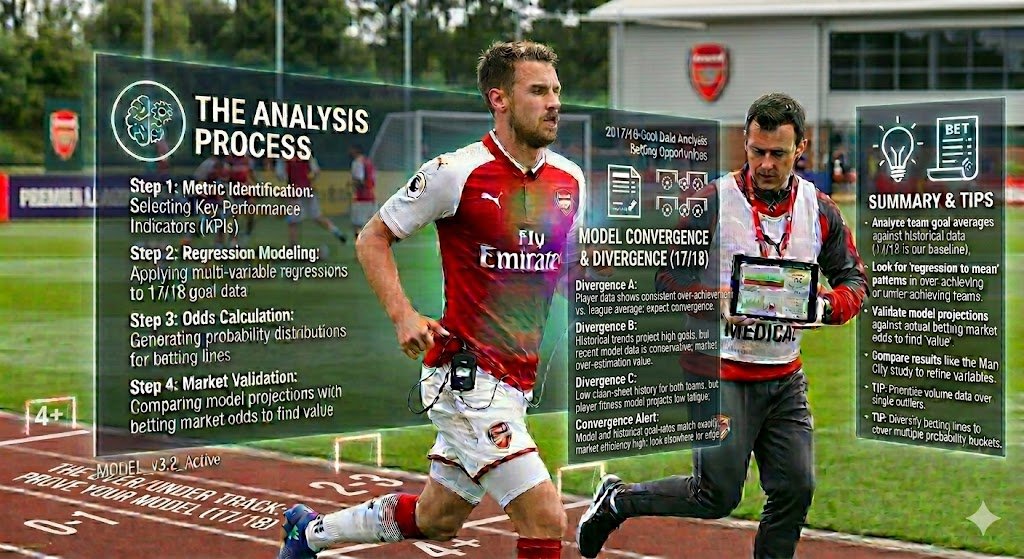
Goal statistics from a full season reveal patterns that are often hidden in individual match analysis. The 2017/18 Premier League season provides a clear dataset where scoring trends, tactical styles, and consistency levels can be linked directly to over and under betting outcomes. The key is not the number of goals alone, but understanding how and why those goals occurred.
Why Raw Goal Totals Are Not Enough
Total goals scored or conceded give a surface-level view, but they do not explain match dynamics. A team scoring frequently might rely on high-tempo play, while another achieves similar numbers through efficiency with fewer chances.
This distinction affects betting decisions. Over-reliance on totals leads to misreading teams that appear high-scoring but actually depend on unstable conditions, such as early goals or defensive errors from opponents.
Identifying Teams That Drive Over Outcomes
Certain teams consistently pushed matches toward high-scoring outcomes due to their style of play. These patterns were not random but rooted in tactical decisions.
To isolate these teams, several indicators stand out:
- High shot volume combined with aggressive attacking transitions, increasing match tempo.
- Defensive structures that leave space behind, allowing opponents to create chances.
- Frequent involvement in matches where both teams score, reflecting mutual vulnerability.
- Consistent creation of high expected goals, not just reliance on finishing efficiency.
These characteristics create repeatable conditions. When both attacking intent and defensive exposure exist simultaneously, matches are more likely to exceed goal thresholds.
Recognizing Teams That Suppress Goals
On the opposite end, some teams consistently produced low-scoring matches. This was not due to lack of quality alone, but often a result of deliberate tactical choices.
Defensive organization, slower buildup, and controlled tempo reduced the number of high-quality chances in their matches. These teams limited both their own scoring and that of their opponents, creating stable under conditions.
The Role of Match Context in Goal Patterns
Goal trends are heavily influenced by context. A high-scoring team may produce fewer goals against defensively disciplined opponents, while a typically conservative team may open up against weaker defenses.
Conditional Shifts in Goal Expectation
The same team can produce different goal outcomes depending on opponent style, match importance, and game state. For example, an early goal can force a defensive team to become more aggressive, increasing total goal potential.
Understanding these conditional shifts prevents rigid thinking. Instead of labeling teams as “over” or “under,” bettors evaluate how conditions affect goal probability.
Converting Goal Data Into Betting Decisions
Turning statistics into actionable decisions requires a structured approach that connects data with match conditions.
A practical sequence helps refine this process:
- Evaluate both teams’ average goals scored and conceded in relation to league averages.
- Compare playing styles to determine whether tempo is likely to increase or decrease.
- Assess recent matches for consistency in goal patterns, avoiding short-term anomalies.
- Consider situational factors such as injuries or tactical adjustments that may alter scoring dynamics.
This process transforms raw numbers into context-aware decisions, reducing reliance on assumptions.
How Odds Reflect Goal Expectations
Goal markets are highly responsive to public perception, especially when teams have visible scoring trends. However, these adjustments are not always precise.
When examining pricing behavior through a sports betting service such as ufabet, it becomes clear that over/under lines often shift quickly for high-profile attacking teams. This rapid adjustment can eliminate value, especially when public demand inflates expectations beyond realistic probabilities.
Finding Value Beyond Standard Goal Lines
Standard over/under markets are not the only way to apply goal analysis. Alternative formats can provide more precise opportunities when used correctly.
Within a casino online environment that offers multiple betting variations, bettors can approach goal trends through team-specific totals or conditional markets. For example, a team that consistently scores but also concedes may offer better value in both teams-to-score markets than in traditional over lines. This flexibility allows for more accurate alignment between analysis and betting choice.
When Goal Trends Become Misleading
Goal patterns can break down under certain conditions. Teams may adjust tactics, key players may be unavailable, or opponents may exploit predictable structures.
A deeper look at failure scenarios highlights common risks:
- Overreliance on recent high-scoring matches without considering opponent quality.
- Ignoring tactical changes that reduce attacking output.
- Misinterpreting outlier results as long-term trends.
- Failing to account for game-state effects, where early goals distort match dynamics.
These situations show that goal data must be interpreted carefully. Without context, even consistent patterns can lead to incorrect conclusions.
Balancing Data With Real Match Conditions
The most effective use of goal statistics comes from combining long-term trends with immediate match conditions. This balance ensures that decisions are grounded in both historical patterns and current realities.
By aligning data with context, bettors can identify when goal expectations are justified and when they are exaggerated by market perception.
Summary
The 2017/18 Premier League goal data provides valuable insights for over and under betting, but only when interpreted beyond raw totals. Teams created consistent scoring patterns through tactical choices, yet those patterns shifted depending on context and opposition. By combining statistical trends with situational analysis and understanding how markets react, bettors can identify more accurate and sustainable opportunities in goal-based betting.